Showing posts with label Canham. Show all posts

Tuesday, March 23, 2021

So Far Away - Swanton Morley and Abraham Lincoln


I’ve previously written about Joseph Canham, his home named Clondalkin, and the cemetery in Swanton Morley. Did you know that through Swanton Morley we have a connection to Abraham Lincoln??


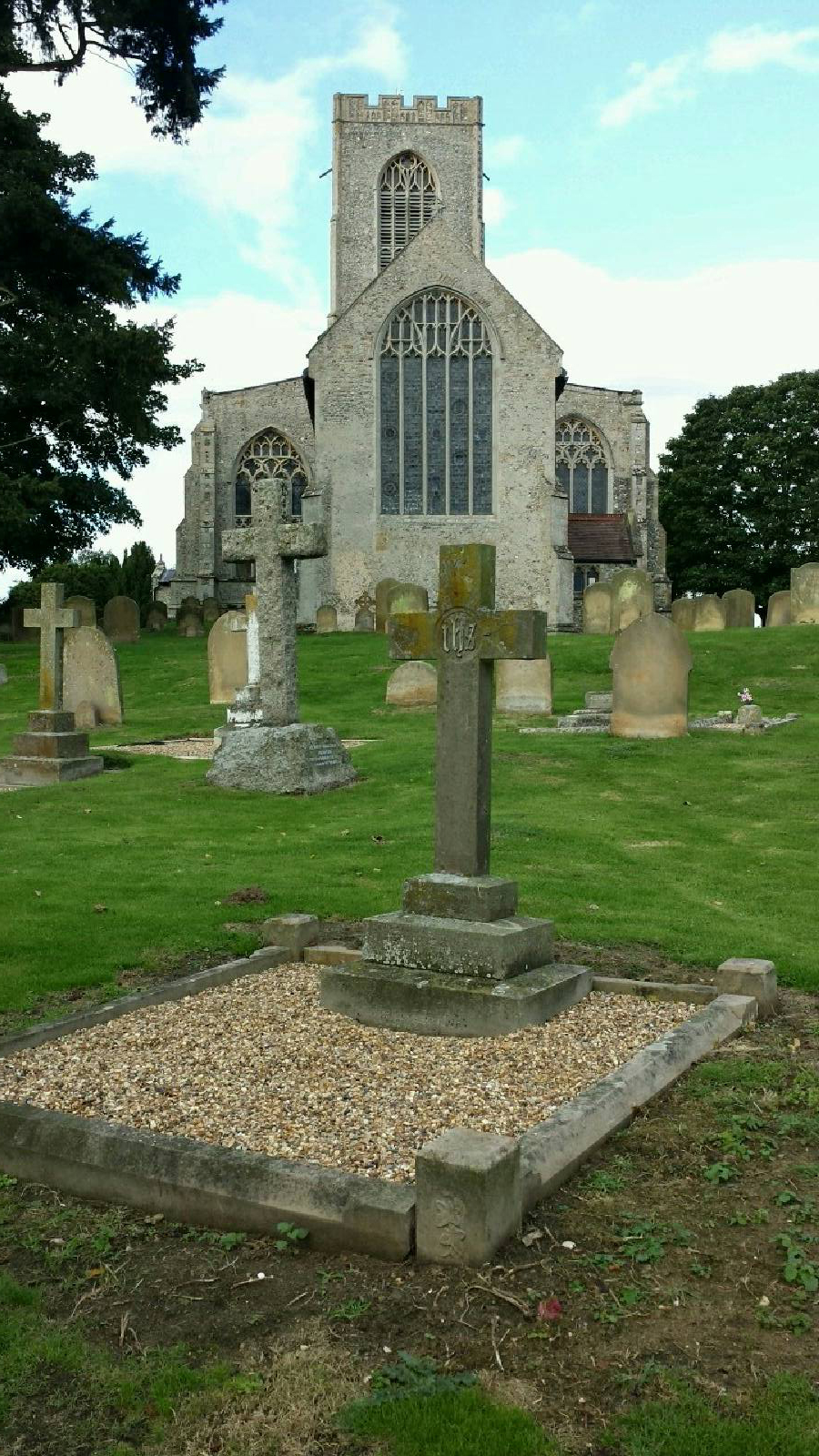
Swanton Morley is a village located at the geographical center of Norfolk County in England. This small village has a long history; it was documented in the 11th-century Domesday Book*, and was home to the ancestors of Abraham Lincoln. And since at least the early 1700s, it has been the home to many of our ancestors. The Canham line alone can be found there as far back as 1789 when Zachariah Canham married Mary Fish in All Saints Church (pictured) which was built in the 1370s. Other family lines branching off from the Canhams in more recent generations, such as the Harvey line which extends from the wife (Mary Ann Dawson Smyth) of John Canham (son of Zachariah Canham) can be traced as far as Christmas Eve 1706 when William Harvey was baptized in All Saints Church. And chances are if the proper records are located, this line will extend even further back in Swanton. “Swanton” is derived from the Old English for herdsman’s enclosure, and “Morley” refers to the fact that the parish was held by Robert de Morli in 1346. The oldest recorded objects found in the area include items from the Mesolithic and Neolithic periods, the Bronze Age, Iron Age, and the Roman occupation. The Angel, a pub run by Canham family members in earlier times, was probably named for a medieval stone carving of a genuflecting angel found in a nearby well house.

Oh, and about that Abraham Lincoln connection? So far, I haven’t found out we’re family, but it could yet happen! Richard Lincoln (1550-1620), a local churchwarden who built the above-named Angel public house was the wealthy grandfather of Samuel Lincoln.
Richard Lincoln disinherited Samuel’s father Edward in favor of his fourth wife, thus throwing the Lincoln family into penury and forcing young Samuel to flee from Swanton Morley to Hingham, Massachusetts. His great-great-great-great-grandson was none other than Abraham Lincoln!


Such a far-away place with a connection to our very genes! How far away exactly? Well, obviously this will vary for each of us, but from my home to the church in Swanton Morley is 4,803.55 miles.

Many of the details of this piece are from Wikipedia. 

 *A record of the “Great Survey” of much of England and parts of Wales, completed in 1086 by order of King William the Conquerer.

Tuesday, August 18, 2020

Canham - The Old Homestead & The Cemetery in Swanton Morley, Norfolk, England


Joseph Canham (1857-1939) was Grammy’s grandfather. He built a house in Swanton Morley and named it Clondalkin. Long ago, the houses were named, not numbered. Joseph’s wife, Jane Mangan (1866-1950) was born in Ireland. Her birth and baptism records only name Oldcastle, Meath, Ireland as her residence. But in the 1939 English Register she lists her place of birth as “Clondalkin.” Both of their death records list their residence as Clondalkin, Swanton Morley.

The photo shows the house in 2011. There is a sign above the front porch that says “Clondalkin.” I zoomed in and added that slice to the photo – it’s fuzzy but readable. I like that the current homeowners have kept the name. Grammy (Josephine Teresa Magurn - “Terry”) remembers visiting her grandparents at Clondalkin as a child. “One time we were visiting my grandparents in Swanton [Morley,] England and my grandfather – Grandjoe we called him, was up a ladder by the house and [when] he turned around I was right behind him. He nearly had a fit. Another time I poisoned his goldfish in the side garden. He used to love to let my grandmother's pet pig – they called the pig Dennis – she was called Nan – out of his pen and he'd chase my sister Joan and I all over the place. I thought it was fun. Joan was petrified.”


This Latin cross with a curbed surround is the resting place for Joseph Canham and his wife Jane. Located in the church yard of All Saints Church in Swanton Morley, Norfolk, England, it is fitting that they are buried where they served so valiantly during their lives. Joseph was the church clerk and sexton, appointed in January 1900. A sexton is an officer of the Church of England charged with the maintenance of its buildings and the surrounding graveyard. From the small book “Our Knickers Were Interesting – A Norfolk Village Childhood” by Daisy Rayner we learn that as the sexton, he rang the church bells and dug the graves. “Today they cannot bury in Swanton Morley churchyard because the graves cave in. It did in those days as well, but Joe knew the way. He made a frame the size of the grave and as he dug a foot or so he would fix a plank in it at the top, like they used to brick wells. The well-sinkers made their wells from the top and dropped them as they went along. For all his cleverness Joe was a most unassuming man, small, wearing glasses and a cap. He was very well loved.” His wife, Jane, was described as a very small, quiet woman. She was the church cleaner. On a side note, the previous sexton and parish clerk was James Hickleton, the husband of Joseph’s aunt Harriet. Hickleton died in January 1900 and Joseph began his 33 years of service. The inscription on their grave marker reads: In every loving memory of Joseph the beloved husband of Jenny* CANHAM who died June 7th 1939 aged 82 years Parish clerk for 33 years Also his beloved wife Jenny* CANHAM died Oct 13th 1950 aged 84 years *This is the only place I have found where Jane is referred to as Jenny.


Thursday, July 25, 2019

An Unexpected Pioneer Ancestor

Pioneers camped at Green River, Wyoming by George Ottinger
On April 16, 1847, a group of 148 Latter-day Saints in 72 wagons left Nebraska and began the 1,031-mile journey to the Salt Lake Valley. They arrived in the Salt Lake Valley between the 21st and 24th of July 1847.
In the years that followed, tens of thousands of Latter-day Saints from around the world would leave their homes and follow the same route to the Salt Lake Valley. This week in Utah we celebrate Pioneer Day on July 24th, in commemoration of that first company of Latter-day Saints who arrived in the Salt Lake Valley in 1847. Since Dad (Ward H. Forman 1926-2006) was the first of our family to join the Church of Jesus Christ of Latter-day Saints, our pioneer ancestors are few, and not direct. But we are related to some of those hardy souls who risked it all to travel to the west where they could worship as they pleased, much as our Mayflower and Puritan and Quaker ancestors did. Surprisingly then, this pioneer story is from Mom’s (Josephine T. Forman 1925-) side of the family! A common ancestor on the Canham side was Emma Girdlestone. This is a bit of her story.
Emma Girdlestone Ridges Smith
Born in March 1835 in Norfolk, England, she joined the church after hearing the missionaries preach in her town. She immediately knew their message to be the true gospel of Jesus Christ. She was baptized at 13 years old. Her parents joined as well. When the gathering to Utah was advised, they saved and prepared to leave their native land and loved ones to start a new life in a foreign land. Emma and her parents left England in the spring of 1856, when Emma was 21. After many delays, they departed from Iowa City, Iowa in July 1856 with the Willie Handcart company. The company had about 500 individuals, 100 handcarts, and 5 wagons when it began. Some days they traveled as much as 30 miles, pushing and pulling their handcarts.
Emma's hand iron, carried across the plains
Emma was a seamstress by trade and she brought her hand iron with her on the trip. Since the travelers were only allowed 17 lbs of belongings each, she could not put the iron on the handcart, but instead tied it to her waist and carried it across the plains. 


  Fall came on early and hard that year. Company provisions ran low causing rations to be cut down to one-half, then one-quarter, and still later to just barely enough to sustain life. Many grew ill from exposure and lack of food.
Ever Onward by Joseph Brickey
The Saints in Salt Lake didn’t learn of the existence of this and other stranded handcart companies until early October. At that point Brigham Young issued an urgent plea to the people for assistance. The first relief company left Salt Lake City 3 days later. By October 19th, the Willie company issued the last of their flour, and the first snowstorm of the season hit. Express rescuers arrived that day and assured the Willie company that help and food were just a day or two away. On October 21st, the needed supplies arrived. They then made a brutal trek over Rocky Ridge in Wyoming during a blizzard on October 23rd. 15 members of the company were buried the next day. Emma’s parents died within 4 days of each other during this time period. Now she was on her own.
Pioneers Entering the Salt Lake Valley by King Driggs
Ten supply wagons met the Willie Company on October 31st, west of Green River. By November 3rd, additional teams had reached them and all the company members were able to ride in wagons. They arrived in Salt Lake City on 9 November 1856. Emma told her descendants that as they came into the valley the sun was shining and flooding the valley with its glory; it looked like a Heaven of peace and rest to those weary travelers. Emma married twice and had at least 8 children, and has a very large posterity now. She always bore a strong testimony of the truthfulness of the gospel. She died in 1914 in Logan, Utah.

Though not all Latter-day Saint pioneer stories were this dramatic, and some were much worse, in general the people were willing to sacrifice in order to gather with others of common belief and live free to practice their religion. Of special note is that the Willie Company also included several members of the Moulton family, ancestors of Annette’s husband, Jess Moulton, as well as several Caldwell family members, who are ancestors of my husband, John D. Van Natter.

A version of this story was originally share at Family Search Memories 22 July 2018

Saturday, June 22, 2019

Joseph Canham (1857-1939) - Woodcarver

Joseph Canham (Father of Josephine Decima Canham, grandfather of Josephine Teresa Magurn) worked as a bricklayer in Swanton Morley, Norfolk, England according to the 1891 census. He was later a gardener, carpenter, and contractor. He was appointed parish clerk and sexton after the death in January 1900 of the previous sexton who was married to Joseph's aunt Harriet Canham Hickleton. He most likely served in this capacity until his death 7 June 1939. The position of parish clerk paid a modest salary and would have allowed him time to have outside employment. Part of his duties would have included digging graves and ringing the church bell.

This photo shows his hobby of woodcarving. He is leaning on his extensively carved gate showing Lord Kitchener who gained fame serving in the Boer Wars. Joseph also carved the swirled posts on the porch in the background. The posts are still there but most of the other carvings are gone now.  
The Village Church, & the Canham headstone
Left: One of Joseph's carved fence posts on display now in Museum of Norfolk Life.

From Our Knickers Were Interesting - A Norfolk Village Childhood  by Daisy Rayner: "He [Joseph] was a gardener for Joseph Springall, the builder, who lived at Greengate House. While Joe was there he made a replica of Swanton Morley church. It was the wonder of everyone who passed. It stood on a mound of purple aubretia and was in the garden until the Springall family died and then it was sold. "

Daisy continues in her book, "Joe did wonderful things and the teen-age youths loved him for he taught them to ring the handbells. He put ships in bottles. He made a policeman which looked like life and when one stepped on a certain place on his path this policeman came to meet you. After a time he had to restrict this for people were afraid to go round to his house. They must have had a guilty conscience." 

From this account, and from viewing his carvings, it's safe to say that Joseph Canham had a wonderful sense of humor! His granddaughter Terry Forman (Josephine Teresa Magurn) recalls him being a big tease. His grandchildren adored him - they called him GranJo.  

If you were to google Joseph Canham, you will find this great photo of GranJo with another model he built. This one is of the Swanton Morley postmill that ground the wheat for the community.
Joseph Canham & postmill model-1936

The Swanton Morley postmill - 1890


This is an updated story originally posted in Memories at Family Search.org 14 Jan 2018

Saturday, April 27, 2019

The Gardener

Gardeners handle living things with living hands.


I find it interesting that so many of our ancestors had the vocation or hobby of gardener. John Magurn (1878-1956) was a gardener in his small village of Kilmacolm, Scotland. For decades he tended the gardens of Bellard (now called Cairns), the estate of the Weir family.
John Magurn with sons Peter and Philip (1930s)
John's father-in-law, Joseph Canham (1857-1939) worked as a bricklayer in his earlier days, but before the turn of the century he was employed as a gardener. Both the 1901 and 1911 census records show his occupation as 'gardener - domestic.' His granddaughter, Terry, recalls that he tended the gardens of a large home at the intersection of his own street- Greengate, and Woodgate Lane. It was just a short walk to work each day, then another walk further on to the church where he served as Sexton and tended to the graveyard.

On the Forman side, Annie Elizabeth Baragwanath Forman (1890-1968) loved her garden. A large section of their side yard property was transformed into gardens. She was serious about her hobby, joining the America Horticulture Society and the International Camellia Society. She was famous for her cultivation of Holly trees. In the photo she is holding a Magnolia Grandiflora (southern magnolia) which she was able to grow back in New Jersey.
Annie E. Baragwanath Forman - Florida 1948
At this Easter time, we can consider another gardener - our Savior, Jesus Christ, depicted in this painting by Rembrandt. 

(From the LDS Living Easter week 2019 series by Emily Belle Freeman and David Butler.)
He comes to us in the middle of our story and He comes as what we need. Think about this for a moment:
  • For Moses He came as a pillar of fire.
  • For Joshua, He came as the Captain of the Hosts.
  • For Peter, He came as a lifeguard.
  • For His mother, He came as a maker of wine.
  • and for Mary, He came as a gardener.
Have you ever wondered why He came for Mary as a gardener?Think about what a gardener does - A gardener watches over and tends and cares for plants and brings about their growth. He does what he knows best. That is exactly what He's going to do for Mary and all the disciples - what He has been doing and will continue to do.
I love that she mistakes him for the gardener because He will be a person who will watch over her with that kind of tender care. He will tend to her now just the way He did for her before.
To watch the Day 4 video: He Meets Us Where We Are

Gardeners handle living things with living hands.